



Jasmine Birtles
Your money-making expert. Financial journalist, TV and radio personality.





 MoneyMagpie team
18th Sep 2026
MoneyMagpie team
18th Sep 2026
Before we get into it, this post isn’t financial advice! It’s simply three tech stocks that have caught my eye this month, for very specific, very current reasons, and a bit about why I’m watching rather than jumping in and buying.
September 2026 has been a genuinely eventful month for tech and AI stocks: blowout earnings that still somehow disappoint the market, a record-breaking quarter from a company most people have never heard of, and a British success story quietly powering half the world’s cloud computing.
Here are the three names on my radar, what’s happening with each right now, and the risk I’d want anyone, including future me, to weigh up before buying.
**This article may contain affiliate links.
Our course teaches you how to buy stocks and shares without overwhelm so that you can avoid the mistakes that lost most investors money!
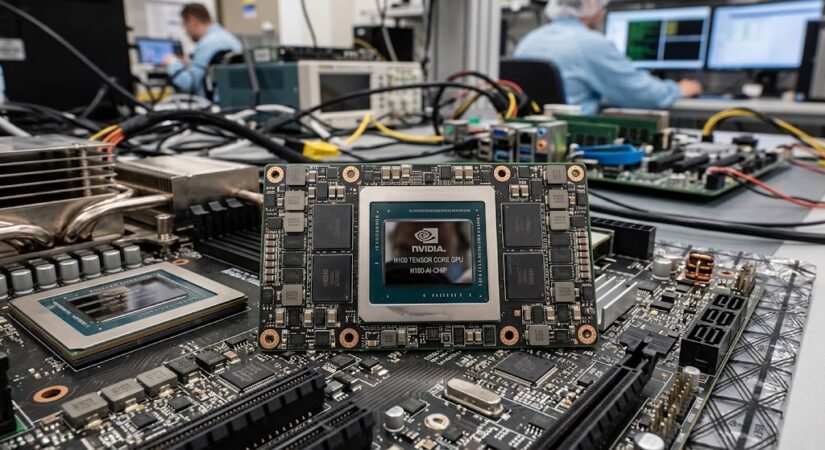
Why it’s on my radar: Micron doesn’t get the headlines that Nvidia or Palantir do, but I think that’s about to change. The company makes memory chips (DRAM and NAND, the components that let computers store and access data quickly), and it controls roughly 24% of the global DRAM market and 15% of NAND, which matters because memory has quietly become the bottleneck holding back the entire AI build-out. Nvidia has reportedly committed around $279 billion through fiscal 2032 to its supply chain, with the bulk earmarked for memory purchases, and Micron is one of only a handful of companies that can produce high-bandwidth memory (HBM) at the scale AI data centres need.
The catalyst I’m watching: Micron reports fiscal Q4 earnings on 30 September 2026, and Wall Street is pencilling in some eye-watering numbers, revenue up roughly 350% year-on-year and earnings per share up over 900%. If those land anywhere close, it could be a genuinely pivotal moment for how the market prices memory stocks.
The risk: Micron’s share price has already climbed over 700% in the past year, so a lot of good news may already be priced in, and memory has historically been a boom-and-bust business. If Micron’s results disappoint even slightly, given how far expectations have run, the reaction could be brutal.
Why it’s on my radar: Arm doesn’t make chips itself, it designs the blueprints that other companies (including Apple, Nvidia and Amazon) license to build their own processors, and it’s headquartered in Cambridge, which makes it one of the closest things UK investors have to a homegrown AI stock, even though it’s listed on the Nasdaq rather than the London Stock Exchange. Arm just posted a genuinely record year: full-year revenue of $4.92 billion, its third consecutive year of more than 20% growth, and its chip designs now sit inside roughly half of all the processors used by the world’s biggest cloud computing providers.
The catalyst I’m watching: in March 2026, Arm launched a new chip design specifically built for “agentic AI” workloads, and has already booked over $2 billion of customer demand for it across the next two financial years, from the likes of Lenovo and Supermicro. That’s a meaningful new growth line on top of its existing smartphone and cloud licensing business.
The risk: Arm makes most of its money from licensing fees and royalties rather than selling physical chips, which is a lovely, high-margin business model when it works, but it also means Arm’s fortunes are tied to how well its customers, the actual chipmakers, are doing, it’s a step removed from the end demand.
Our course teaches you how to buy stocks and shares without overwhelm so that you can avoid the mistakes that lost most investors money!
Why it’s on my radar: Broadcom makes custom AI chips for some of the biggest names in tech, and its most recent quarterly results, reported 2 September 2026, showed AI-related revenue more than tripling to $16.7 billion, up 221% year-on-year. The company has effectively locked in years of future earnings, with Google, Anthropic and OpenAI all named as customers for custom chip designs stretching out to 2028, and Broadcom itself now guides to $58 billion of AI revenue for the full year, rising to a forecast $115 billion in 2027 and $230 billion in 2028.
The catalyst, and the cautionary tale: despite that extraordinary growth, Broadcom’s shares actually fell after the announcement, because its guidance for the next quarter, while still showing 236% growth, came in slightly below what some analysts had modelled. The exact same thing happened after its previous quarterly results too.
The risk, and the real reason I’m watching rather than acting: this is the one I find most instructive for beginners. When a stock’s expectations get high enough, even genuinely excellent results can trigger a sell-off simply because they weren’t excellent enough. It’s a reminder that buying a great company at the wrong price, or the wrong moment of sky-high expectations, is still a real risk.
It can be tempting to jump in and buy exciting stocks, especially when headlines are positive. However, it’s sometimes better to watch and wait. The best investment decisions are made carefully and with a solid plan of action- rather than jumping in out of fomo.
Our course teaches you how to buy stocks and shares without overwhelm so that you can avoid the mistakes that lost most investors money!
Risk Disclaimer: This article reflects my own personal opinions and watchlist, and is for general information and educational purposes only, it does not constitute regulated financial advice or a recommendation to buy or sell any stock. Share prices, earnings forecasts and company guidance mentioned above can and do change, and all investments can go down as well as up in value, you could get back less than you put in. Please do your own research, or speak to a regulated financial adviser, before making any investment decisions.

Direct to your inbox every week
New data capture form 2023
Your money-making expert. Financial journalist, TV and radio personality.







Leave a Reply