





Jasmine Birtles
Your money-making expert. Financial journalist, TV and radio personality.



 Moneymagpie Team
25th Nov 2026
After a spectacular run, gold has had a rough few weeks. The price fell nearly 7% in October and around 8% more in November so far, hitting a 14-month low on 20 November. Spot gold was trading at about $3,559 an ounce on the morning of 25 November, compared with around $4,032 just a month earlier, according to Fortune and CNBC reports.
So if you’ve been thinking about adding gold to your portfolio, is this a golden opportunity or a warning sign? In this article, we look at why gold is falling, what’s still supporting it over the long term, and how to decide whether it’s right for you. And if you want to hear the experts debate it in person, the MoneyMagpie Gold & Wealth Conference 2027 is coming to Westminster on 2 February.
Gold doesn’t pay interest or dividends, so it tends to look less attractive when interest rates rise. US inflation has stayed stubbornly high, and markets now see a very strong chance the US Federal Reserve will raise rates again at its 8 to 9 December meeting. The Bank of England is also expected to consider another rise.
Stock markets have been jittery this month, particularly AI and chip shares after Nvidia’s CEO resigned. When shares fall sharply, some investors who have borrowed to invest are forced to sell other assets, including gold and silver, to raise cash. That can push gold down even when you’d expect it to act as a safe haven.
Gold had a remarkable rally, averaging $4,262 an ounce in the third quarter of 2026, the third-highest quarterly average on record according to the World Gold Council. After a run like that, some investors simply cash in.
Short-term falls don’t necessarily change the bigger picture. Several long-term forces remain in place:
Honestly? Nobody knows where the price will go next, and anyone who tells you otherwise is guessing. Here are the arguments on both sides.
For most investors, the sensible approach isn’t to try to time the bottom, but to decide how much gold you want as part of a balanced portfolio (many people keep it to a modest slice) and build up gradually. Buying a little at a time, known as pound-cost averaging, helps smooth out the bumps.
There are several ways to own gold, from physical coins and bars to gold ETFs, digital gold and gold mining shares. Each has different costs, risks and tax treatment. For example, UK gold sovereigns and Britannias are legal tender, which means they’re exempt from Capital Gains Tax. We cover all the options in our guide to the best place to buy gold online and our comparison of gold coins vs ETFs.
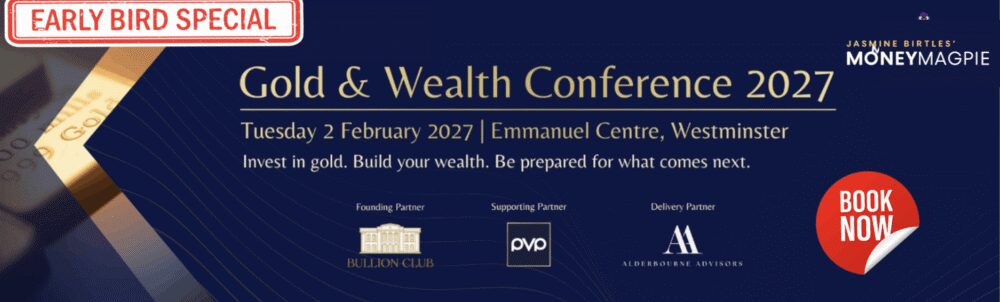
Should you be buying gold now? Bullion or mining shares? What’s next for money? These are exactly the questions we’ll be tackling at the MoneyMagpie Gold & Wealth Conference 2027 in Westminster on Tuesday 2 February.
Hosted by MoneyMagpie founder Jasmine Birtles, the day features Dominic Frisby, Russ Mould, Tim Price, Charlie Morris, Harry Thorne of Bullion Club and John Butler, with a special appearance from Andrew Griffith MP. You’ll hear the arguments, ask your questions and meet the people behind the ideas.
Gold’s recent fall is a reminder that even “safe haven” assets can be volatile in the short term. But for long-term investors, a dip can also be a chance to build a position at a better price, as long as gold fits your goals and you don’t overdo it. Do your research, keep it as part of a diversified portfolio, and if you want to learn from the experts, we’d love to see you in Westminster.
Disclaimer: MoneyMagpie is not a financial adviser. This article is for general information and education only and is not personal investment advice. The value of gold and other investments can fall as well as rise, and you may get back less than you put in. Tax treatment depends on your individual circumstances and may change. MoneyMagpie is hosting the Gold & Wealth Conference 2027, and Bullion Club is the event’s founding partner.

Direct to your inbox every week
New data capture form 2023
Your money-making expert. Financial journalist, TV and radio personality.







Leave a Reply