



Jasmine Birtles
Your money-making expert. Financial journalist, TV and radio personality.





 Ruby Layram
6th Jul 2026
Ruby Layram
6th Jul 2026
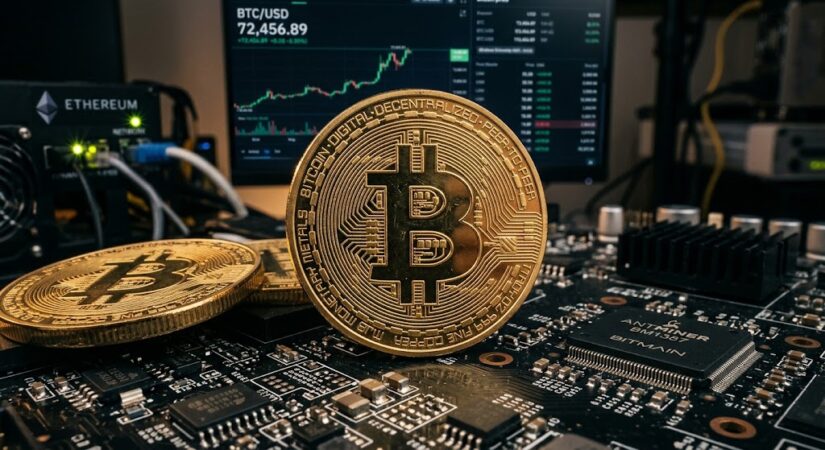
It’s been a tough year for Bitcoin investors.
After another strong run in 2025, the world’s largest cryptocurrency has lost significant ground during the first half of 2026. Rising interest rates, weaker investor sentiment and record outflows from Bitcoin ETFs have all contributed to the decline, leaving many investors wondering whether this is simply another correction or the start of a longer bear market.
Despite the recent weakness, many of the world’s biggest financial institutions remain surprisingly optimistic about Bitcoin’s long-term future.
So, where could Bitcoin go next?
Here’s a look at the latest expert forecasts, what’s driving the market and whether Bitcoin is still worth considering in July 2026.

Bitcoin enters July trading at around $60,000, having fallen sharply from the highs seen last year.
The biggest factor behind the decline has been investor demand. US spot Bitcoin ETFs have experienced record outflows during recent months as investors have become more cautious towards riskier assets amid higher interest rates.
Although sentiment remains fragile, Bitcoin has started to stabilise after finding support around the $58,000-$60,000 level.
Several factors have weighed on the cryptocurrency market this year.
Bitcoin is often viewed as a “risk asset.”
When interest rates rise, investors can earn attractive returns from cash and government bonds, making speculative investments like cryptocurrencies less appealing.
With the US Federal Reserve expected to keep monetary policy relatively tight, this has reduced demand for Bitcoin throughout 2026.
One of the biggest stories has been the reversal in ETF flows.
After attracting billions of dollars during 2024 and 2025, US spot Bitcoin ETFs have seen significant withdrawals this year.
Citi recently cited these outflows as one of the main reasons for lowering its Bitcoin forecast.
Technology shares have once again captured investors’ attention.
The continuing AI boom, combined with the recent SpaceX IPO, has encouraged many investors to move money back into equities instead of cryptocurrencies.
Although Bitcoin has struggled recently, forecasts for the end of 2026 remain surprisingly optimistic.
Standard Chartered continues to believe Bitcoin could recover to $100,000 by the end of 2026.
The bank’s Head of Digital Assets Research, Geoff Kendrick, has described the recent sell-off as a potential buying opportunity rather than the end of Bitcoin’s long-term bull market.
He believes institutional adoption and renewed ETF demand could help drive prices higher during the second half of the year.
Investment research firm Bernstein remains one of the most bullish voices on Bitcoin.
Its analysts continue to forecast a $150,000 Bitcoin price by the end of 2026, arguing that institutional investors are fundamentally changing Bitcoin’s market cycle.
Rather than following the traditional four-year boom-and-bust pattern, Bernstein believes increasing institutional ownership could create a longer, more gradual bull market.
Not everyone is convinced.
Citigroup recently lowered its 12-month Bitcoin forecast to $82,000, down from its previous target.
The bank cited weaker ETF demand, slower institutional adoption and uncertainty surrounding US crypto regulation as reasons for its more cautious outlook.
In a worst-case scenario, Citi believes Bitcoin could briefly fall towards $53,000 before recovering.
Several events could determine where Bitcoin heads over the coming weeks.
If investors begin expecting interest rate cuts later this year, cryptocurrencies could benefit as appetite for risk assets improves.
Many analysts believe ETF inflows have become one of the most important indicators for Bitcoin.
If investors begin putting money back into Bitcoin ETFs, it could provide meaningful support for prices.
Progress on cryptocurrency regulation—particularly in the United States—could improve investor confidence and encourage more institutional participation.
Bitcoin remains highly sensitive to investor psychology.
Positive news can trigger rapid rallies, while negative headlines can lead to equally sharp declines.
I think Bitcoin can still have a place in a diversified investment portfolio—but only for investors who understand the risks.
Unlike shares, Bitcoin doesn’t generate profits or dividends.
Its value depends almost entirely on what other investors are willing to pay for it.
That makes it far more volatile than traditional investments.
Personally, I’d never build my portfolio around Bitcoin.
Instead, I’d view it as a small satellite holding alongside more diversified investments such as global index funds, high-quality shares and other asset classes.
For beginners especially, it’s usually sensible to build a solid investment portfolio before allocating a small percentage to cryptocurrency.
Bitcoin has had a challenging first half of 2026, but the long-term debate is far from over.
While recent ETF outflows and higher interest rates have weighed on prices, many professional investors continue to believe Bitcoin could recover during the second half of the year.
Whether those forecasts prove correct remains to be seen.
If you’re thinking about investing, remember that Bitcoin is one of the most volatile assets available. Prices can rise dramatically—but they can also fall just as quickly.
That’s why it’s important to invest only what you can afford to leave invested for the long term and ensure cryptocurrency forms just one part of a diversified portfolio.
MoneyMagpie is not a financial adviser. This article is for educational purposes only and should not be considered financial advice. Cryptocurrency is highly volatile, and you could lose some or all of your investment. Always carry out your own research before investing.

Direct to your inbox every week
New data capture form 2023
Your money-making expert. Financial journalist, TV and radio personality.







Leave a Reply