

Jasmine Birtles
Your money-making expert. Financial journalist, TV and radio personality.




 Moneymagpie Team
2nd Mar 2026
Moneymagpie Team
2nd Mar 2026
Over the course of the past several years, financial markets have become as accessible as they ever have been in recent memory. Mobile platforms, fractional shares, crypto assets, and CFD instruments have provided access to trading for millions of people who had no idea what an order or a spread meant in the first place.
Brokerage commissions in many areas have fallen to zero. Information that twenty years ago was the special preserve of investment bank analysts is now accessible on a smartphone screen.
Due to that accessibility, there is a hidden cost. The lower the barrier to entry is, the less time people tend to spend getting ready. This is exactly where the gap is widening between those who learn how to trade in a systematic way and those who pay so much to learn how to trade by making losses on a live account. Practising market mechanics using a demo trading account is one such way whereby a trader should be able to work through decisions without having any real financial consequences. Capital, for example, provides such an environment with a whole range of assets and market conditions closely replicating that of live trading.

What follows is a look at trading through a clear-eyed lens – which mistakes have the heaviest price tags, how discipline actually forms, and why knowledge of technologies but not the psychological stability to go with it, is worth surprisingly little.
There is a widespread assumption that if we learn enough of such indicators, one day markets shall be predictable. In reality, even traders with decades behind them have losses riding on a regular basis. The question is never if mistakes are going to happen – it is how large their consequences will be.
Markets are not static. Their behaviour changes with the level of macroeconomics, the news, what the central bank decides, what corporations are earning, and hundreds of other variables. A strategy that worked well for a period of months may begin misfiring – not because the trader did anything wrong, but because the market regime changed. Adaptability, in this environment, has a better price than whatever certain fixed set of rules.
The 2020-2022 season was a good example of this. The unprecedentedly sharp pick-up following the pandemic selloff surprised many bears. Then the Fed’s rate-hiking cycle had the same lesson for those who were positioned for further growth. Neither side was necessarily wrong in its analysis – both simply failed to take a changing context into account.

Most beginners expend their energies in locating the “right” asset or the perfect entry point. Far less attention is paid to what to do once the position is opened – how to manage it, where to cut the loss and when to take a profit.
The concept of risk/reward ratio sounds almost too basic to mention, but it gets ignored with surprising regularity. Opening a trade with the possibility of making fifty dollars but the possibility of losing two hundred dollars is a mathematically losing proposition, even if it works a couple of times in a row.
Another scenario that can be observed repeatedly is the missing stop loss, or one that is manually moved further and farther as the price approaches the stop loss. The logic is waiting for a recuperation. The result is a minor technical move turning into a position tying up a significant piece of the account for weeks. Platforms such as Capital give traders the opportunity to set automatic limits at the point when a trade is opened, which removes at least some of the emotional decision-making from the equation at a time when it is important.
The behavioural economics literature – Kahneman, Thaler, Shiller – teaches us one thing very clearly: the human brain just is not geared for financial markets. Losses are registered more powerfully than equivalent gains. Patterns get perceived where there are none. A string of successful trades leads to overconfidence that almost never survives the next loss.
These tendencies of cognition are not rigid for reading theory. They take over at exactly the moment a position plays out against you and a decision must be made in a hurry. This is why traders with actual experience easily and consistently point to the trading journal, a registry of every trade, along with the reasoning and emotional state behind it, as a practical instrument of discovering behavioural patterns that would otherwise remain invisible.
In their seminal work published in Econometrica in 1979, psychologists Daniel Kahneman and Amos Tversky found that losses are “psychologically weighted” about 2 or 2.5 times heavier than equivalent gains – results that have now been reproduced worldwide and in 19 different countries – and the rationale for why traders tend to hold onto losing positions far too long while cutting winners too soon.
A study on US retail trades from 2010 to 2019 found that, on average, the retail investors lose 2.60 basis points on the day of trade (weighted by dollar value), with the losses being concentrated in attention-grabbing stocks – thus proving that the main culprit here is not asset selection but poorly timed entries and exits based on emotional reactions to market movement.
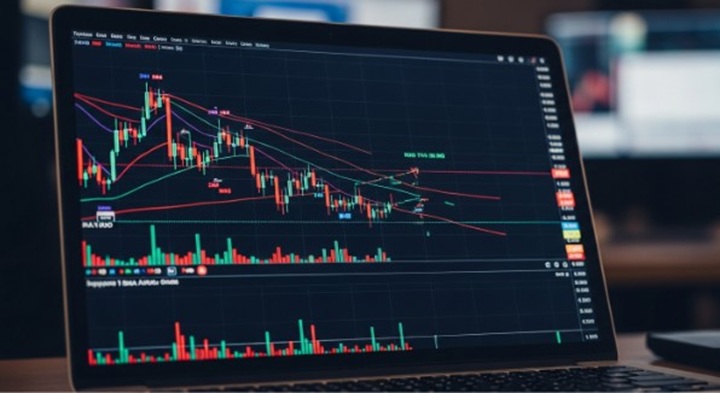
Charts, candlesticks, support and resistance levels, moving averages – these are all part of a common language for describing the behaviour of prices. Being aware that language has an actual value. A few things though, are worth understanding from the beginning.
Technical analysis describes the past behaviour of prices and assumes that similar patterns can recur. That is not deterministic forecasting but is probabilistic thinking. Beyond that, most classic patterns are such common knowledge that markets often manipulate against obvious setups – especially in competitive markets against algorithmic systems that process the same data in milliseconds.
Tools such as RSI, MACD and Bollinger Bands are not oracles. Their usefulness depends a lot on the environment of the market in which they are used and whether there are any other factors that support the same reading. Traders who use only one indicator without taking into account the bigger picture accumulate more false signals than true ones.
Running in parallel with technical approaches is fundamental analysis – assessment of an asset on the basis of hard underlying data: company financials, macroeconomic statistics, and regulatory decisions. For the long-term investor, it is often the primary framework. For shorter-term traders, it is more of a philtre – a way of understanding the bigger picture in which price is moving.
One of the less disappearing modern challenges is sheer information volume. Dozens of reports, commentaries, and forecasts come up each day. Much of what gets published is already priced in by the market in advance – this is the essence of “it’s already in the price”. The rest, which are truly unexpected developments, make an asset move sharply, and that can happen within minutes.
This makes dealings around macro events particularly tricky. Even if a trader is correct about pointing to a direction – for example, the Fed will raise rates – the market reaction can be in the opposite direction if the decision differs from expectations with respect to how it’s worded and/or forward guidance. Traders call this “buy the rumour, sell the news” and it has fouled out plenty of good-reasoned positions.
Those with a serious interest in trading go through recognisable phases. First is the familiarity with instruments, platforms and core concepts. Then follows the tryout of learned strategies – often with disappointing results. Then comes the slower work of going through trades and adjusting.
That cycle takes some time – often years. This is why starting with a small size or with a practice account is recommended, not so much as a shortcut for success by simulation, but to make mistakes, if it’s the case, without it being possible to get permanently wounded. Working through real market conditions without actual capital at stake provides traders with a space in which to develop habits of decision-making before the consequences are made permanent.
Something else that gets ignored early on is the selection of the market and the instrument. A trader who truly understands the technology sector is likely not to take the same edge and extend it to commodity futures, where completely different forces prevail. Specialisation is not a constraint – it is considered strategic position.
For all the technological shifts – the rise of algorithmic systems, access to huge datasets, the expansion of available instruments – some things about trading do not change. Markets continue to be as much driven by expectations as facts. Psychological biases don’t go away from experience. Discipline and managing the risk are still more decisive than getting the forecast right.
This piece is not a roadmap, nor is it an investment recommendation. It is a primer of the issues that are worth sitting down and thinking about before getting seriously involved with financial markets. Markets are complex adaptive systems, and recognising this fact is the start of taking a more considered approach to participating in them.
This material is provided for informational and analytical purposes only and does not constitute financial, investment, or legal advice.
Disclaimer: MoneyMagpie is not a licensed financial advisor and therefore information found here including opinions, commentary, suggestions or strategies are for informational, entertainment or educational purposes only. This should not be considered as financial advice. Anyone thinking of investing should conduct their own due diligence.
Your money-making expert. Financial journalist, TV and radio personality.