

Jasmine Birtles
Your money-making expert. Financial journalist, TV and radio personality.



 Moneymagpie Team
23rd Oct 2026
A new pair of glasses can easily cost more than a weekend away, yet some of the biggest savings have nothing to do with discount codes.
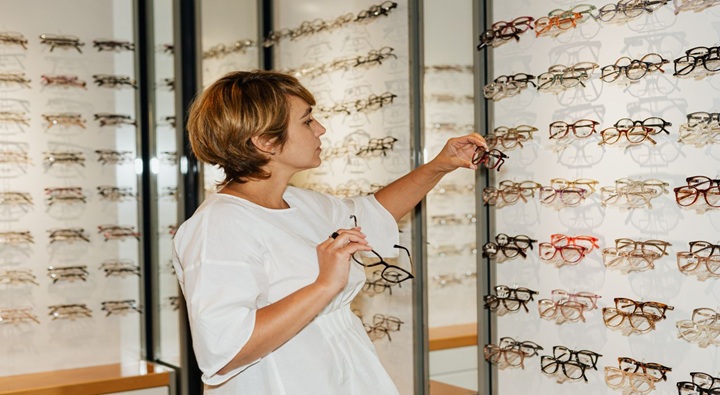
Glasses are one of those costs most of us never question. You have your eye test, someone walks you over to the frame wall, and by the time you’ve added thinner lenses and a coating or two, the bill has crept well past what you meant to spend.
A fair chunk of that is optional. Some of it shouldn’t be coming out of your pocket at all.
In this guide: free eye tests, what your employer owes you, your prescription rights, buying online, lens extras, reglazing, one pair versus two, and when to buy.
Check this before you book. NHS eye examinations are free for everyone living in Scotland. In the rest of the UK you’ll usually qualify if you’re 60 or over, claim certain benefits, are registered blind or partially sighted, or have diabetes or glaucoma. If you’re 40 or over and a parent, brother, sister or child has glaucoma, you qualify too.
The NHS Business Services Authority has the full list. It takes two minutes to check, and it’s money most people hand over without a second thought.
Plenty of people never ask about this one.
If you use a computer, laptop or tablet for work every day, for an hour or more at a time, you count as a display screen equipment user. Under the Health and Safety (Display Screen Equipment) Regulations 1992, your employer has to provide an eye test if you ask for one, and they have to pay for it.
Glasses are where people get caught out. If the test shows you need special glasses for the distance you sit from your screen, your employer has to pay for them. If your ordinary prescription does the job, they don’t.
The Health and Safety Executive sets out the rules. Either way, have a word with HR before you book and pay for a test yourself.
After every sight test, the optician has to give you a written prescription, or confirm in writing that you don’t need one. It’s yours to take anywhere, so you’re free to shop around rather than buying on the spot.
While you’re in the chair, ask them to measure your pupillary distance (PD) and write it down. It’s the gap between your pupils, and it tells the lab where to centre your lenses.
Opticians don’t have to put it on your prescription, so it’s often missing. If you plan to buy online, you’ll need it, and having it measured properly beats guessing with a ruler in the bathroom mirror.
Online opticians don’t have high street rents to cover, and you can see it in the prices. Specialists such as Glasses2You sell prescription glasses online from £19.95, with free tracked UK delivery on orders over £40.
Say you want everyday glasses and a pair for sunny days. Using their prices:
Two pairs for under fifty quid.
Before you order anywhere online, check two things: that the price includes lenses, not just frames, and how long you’ve got to send them back if they don’t suit you.
Lens upgrades are where bills balloon, so it pays to know which ones earn their keep.
If you have a strong prescription, thinner (high-index) lenses make your glasses lighter and stop the edges looking like the bottom of a milk bottle. With a mild prescription, standard lenses are usually fine. Ask the optician how strong your prescription is before you pay to upgrade.
This one’s worth it if you spend long days at a screen or drive a lot after dark, because it cuts glare from lights and reflections.
Many retailers bundle coatings into lens packages. Add up the extras you’d choose anyway and compare that with the package price, rather than ticking every box on the menu.
If you love your current frames and they’re in good condition, you don’t need new ones. Reglazing means fitting new lenses into the frames you already own, and online it starts from around £35 for full-rim frames.
It’s also one less pair of glasses gathering dust in a drawer.
Prescription sunglasses are lovely to have, but a second full pair can double what you spend. There are cheaper ways round it.
When you reglaze an older pair, ask for tinted lenses. A sunglass tint is often a small add-on, around £10 at some online retailers, and it turns last year’s frames into a pair of prescription sunglasses.
Photochromic lenses are the other option. They darken outdoors and clear indoors, so one pair does both jobs.
If you’d rather have dedicated prescription sunglasses, buy them in the same order as your everyday pair so you clear any free delivery threshold in one go.
Online opticians run sales through the year, often around bank holidays and the change of seasons. If you’re not in a rush, it’s worth waiting for one.
Sign up to a retailer’s newsletter before you buy, as many offer money off your first order. You can always unsubscribe once you’ve had your glasses.
Whatever you buy, read the returns policy first. Look for at least 30 days and a money-back guarantee, because frames that look great on a screen don’t always look great on your face.
Ask three quick questions: is my test free, will my employer pay for it, and can you write down my PD?
None of them costs a thing to ask, and between them they could save you a packet before you’ve even picked a frame.
Disclaimer: MoneyMagpie is not a licensed financial advisor and therefore information found here including opinions, commentary, suggestions or strategies are for informational, entertainment or educational purposes only. This should not be considered as financial advice. Anyone thinking of investing should conduct their own due diligence.
Your money-making expert. Financial journalist, TV and radio personality.