

Jasmine Birtles
Your money-making expert. Financial journalist, TV and radio personality.




 Moneymagpie Team
27th Oct 2026
Finding home care for seniors living alone can feel like a maze with no map. Cost, funding and choice look very different in the United States and United Kingdom. Each country has its own rules, paperwork and surprises. Knowing what separates the two systems puts you in a stronger position to identify trusted options and make decisions with confidence.
Cost is usually the first shock for families. Prices can vary with your area, the type of service and how complex the care is. Hiring through an agency or an independent caregiver can also affect the price. How you pay can matter as well, whether out of pocket, through long-term care insurance, Medicaid waivers or veteran benefits.
Across the US, the median cost of home care in 2023 reached $62,400 a year for full-time homemaker services. Full-time home health aide care cost $68,640, while round-the-clock home health aide care reached $288,288.
The UK system works differently, with the National Health Service (NHS) handling clinical care and local councils overseeing social care. NHS guidance puts the typical cost of a carer visiting your home at around £20 an hour. Live-in care starts from around £800 a week and can reach £1,600 for higher needs.
Those price tags raise an obvious question about who pays. Families in the US often piece funding together. Medicare helps with some medical costs but typically does not cover assisted living or custodial care. Medicaid may cover long-term care for people with limited income, depending on the state. The Program of All-Inclusive Care for the Elderly blends both to help people stay home.
England takes a different route, starting with a care needs assessment. A council means test evaluates your earnings and assets, including savings and property. For those with less than £14,250 in capital, the council disregards your capital, though you still contribute from your income. Charging rules and benefits can differ in Scotland, Wales and Northern Ireland, so check the rules where you live.
Before you choose or pay for care, a few practical checks can help protect your budget:
Funding is only part of the picture, because oversight differs too. In England, one independent body, the Care Quality Commission (CQC), regulates health and social care providers. You can check CQC’s ratings for home care agencies, which use a four-point scale of Outstanding, Good, Requires Improvement and Inadequate.
In the US, oversight can fall to several bodies, since state licensing and Medicare certification both apply to home health agencies.
Non-medical home care offers non-clinical help with everyday routines like bathing, dressing, meal preparation, light housekeeping, shopping and companionship. Medicare-certified home health provides short-term, medically necessary skilled care such as nursing and therapy. Even then, what Medicare covers at home excludes 24-hour care, unrelated homemaker services and personal care alone.
Once you know who oversees providers, the next question is how involved you want to be. In England, you can usually choose council-arranged care, private self-funding or a direct payment from the council that lets you arrange care yourself. Your capital against the £23,250 threshold, the control you want over your routine and your appetite for paperwork all shape the answer.
US households face a similar balancing act. The best fit depends on your budget, your comfort with risk and how much administrative or legal responsibility you want to take on.
Careful vetting helps with either route. Confirm each agency holds an active licence with your local or state health department, as the National Institute on Aging advises. Find out whether it is bonded, which may help cover theft or property damage. You should also check whether the firm carries general liability and workers’ compensation insurance. Screening matters too, including criminal background checks, reference checks and drug testing.
Ask about staff certifications, ongoing training and how the agency pairs a caregiver with your relative’s personality, routine and needs. Finally, request a written breakdown of hourly rates, minimum shifts, weekend or holiday surcharges and deposit policies.
Beyond choosing a provider, technology can add another layer of support at home. Telecare has become a familiar part of UK home care, with around 2 million people using telecare. These tools may offer families extra reassurance when a parent lives alone.
Digital monitoring tools can help seniors stay independent at home while giving family members real-time updates. Many personal alarms and monitoring systems can include sensors that alert family, carers or a monitoring service. Common sensor types include:
If you’re searching for the best home care for seniors living alone, two providers offer a useful starting point. Comparing how each handles cost, funding and local oversight can help you decide what to ask on a first call.

If your parents live in the US, Village Caregiving (VCG) is a non-medical in-home care provider based in Barboursville, West Virginia. Its mission is “Keep your heart at home.”
The in-home care agency operates in 21 states, making it easier for families in different regions to find a nearby office. The agency says it can tailor services to different needs, from companionship to meal preparation and light housekeeping.
VCG has more than 10 years of experience and aims to provide care that honours the dignity and comfort of seniors. It describes matching in-home caregivers with clients based on compatibility and shared interests, alongside personalised care planning.
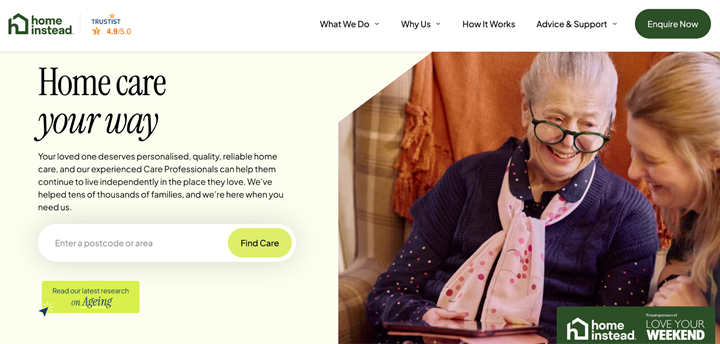
In the UK, Home Instead has operated since 2005 and has grown to more than 255 locally owned offices. Each office is independently owned and run by people who live locally, with a national office in Warrington, Cheshire. The business is also part of Honor, a care technology provider.
That local structure may give you a nearby team to speak with when you compare options. Because each office runs independently, it can help to ask your nearest team about pricing and to check its CQC rating. Whichever provider you consider, the same questions about licensing, screening and written pricing apply.
After comparing providers, a few practical questions often arise for families with a parent who lives alone. Short, clear answers can make the next step feel more manageable.
Home healthcare provides clinical, doctor-prescribed treatment such as skilled nursing and therapy. Home care offers non-medical help with daily routines like bathing, meals and companionship.
In England, ask your council for a care needs assessment and a financial assessment, which can show whether you may be eligible for support. Benefits such as Attendance Allowance and Pension Credit may also help, depending on your circumstances.
Start by confirming the agency’s legal credentials and insurance, then ask how it screens and trains its staff. A trustworthy agency should also provide clear written pricing and explain who oversees its work.
Understanding costs, funding and oversight on both sides of the Atlantic puts you in a stronger position to make a well-informed choice. Both countries offer support routes. A little preparation can make them easier to find. Whether you start with a care needs assessment or a conversation with a local provider, that first step may bring clarity.
Disclaimer: MoneyMagpie is not a licensed financial advisor and therefore information found here including opinions, commentary, suggestions or strategies are for informational, entertainment or educational purposes only. This should not be considered as financial advice. Anyone thinking of investing should conduct their own due diligence.
Your money-making expert. Financial journalist, TV and radio personality.