Jasmine Birtles
Your money-making expert. Financial journalist, TV and radio personality.




 Moneymagpie Team
16th Mar 2026
Moneymagpie Team
16th Mar 2026
As remote work becomes more common, offices are increasingly being built in backyards and gardens. These days, more professionals are opting for an outside office as they seek a dedicated space away from the house. The main challenge, however, is ensuring that these structures remain effective in all seasons. A well-designed outside office is a dedicated, climate-controlled, and ergonomic workspace integrated into the environment so it can be used year-round without disruption from the weather. The best way of assessing this viability is through the ‘4 – season viability framework’, which is a scoring system from 0 – 100 points. It measures the viability of the outside offices in four categories; Climate Control Capacity (0 – 30 points), Connectivity Resilience (0 – 25 points), Ergonomic Sustainability (0 – 25 points) and Structural Permanence (0 – 20 points). Spaces that achieve a score of 75 points or higher have demonstrated that they can be productive all year round. Spaces scoring less than 60 points are mostly seasonable novelties.
Successful all-season climate control in an outside office depends on high-quality insulation, heating, cooling, and ventilation systems. The Climate Control Capacity is part of the 4-Season Viability Framework which can give scores of 30 points maximum. Proper insulation is the first line of defense against extreme temperatures. The required “R-value” varies depending on where you live. The colder the climate, the higher the R-value requirement. In many regions, for example, attics require insulation with an R-49 to R-60. Wall insulation typically requires R-13 to R-20+ insulation depending on climate zone. Spray foam insulation has an R-value of around 6.0–6.5 per inch and superior air sealing properties.
Efficiency is essential in heating small external offices. Cold-climate air-source heat pumps are highly efficient, using about 75% less electricity than electric resistance heating, and are becoming increasingly popular because they provide both heating and cooling. Mini-split systems provide cooling with accuracy without the need for ductwork. Weatherproofing standards help a structure maintain its durability and comfort. A tightening of building envelopes which specify air leakage of ≤3 ACH50, and continuous insulation are becoming more prevalent in construction standards.

Reliable power and internet are essential for a fully effective year-round outside office. Connectivity resilience accounts for up to 25 points in the framework. Power transmission technologies must be robust enough to maintain continuous operation of these systems. Contractors often recommend either a dedicated electrical sub-panel or a 20-amp, 240-volt circuit, especially for mini-split HVAC systems. The professional installation of electrical hookups can add considerably to project costs, with weatherproof custom structure costs £10,000 to £20,000+.
Using a UPS to safeguard vital equipment or a generator ensures power backup for weather-related outages. Connection to the internet is equally important. There’s a good chance that fiber internet is already available in your area. Fiber offers low ping and fast upload speed needed for video calls and work on the cloud. When direct fiber isn’t an option, a run from the main home router or from a strong outdoor node of a mesh Wi-Fi system can do the trick.
Cellular hotspots or 5G home internet can act as a reliable backup. On average, a construction cost for an outside office structure may normally set you back by anything from £10,000 to £30,000+, depending on features.
Ergonomic design ensures comfort and health during 6–8 hour workdays. This contributes to the Ergonomic Sustainability score (up to 25 points). This refers to improving the lighting, chair, and acoustics to lessen strain and improve concentration. Natural light is essential but can be problematic if not properly controlled. Windows placed strategically with removable blinds or shades help to get daylight at different times of the day and year. The artificial light should resemble natural light and be adjustable to minimize eye strain.
An adjustable ergonomic chair with lumbar support, seat height adjustment, and armrests is essential. The desk must allow for ideal posture and preferably have a sit-stand to encourage movement. Proper ergonomic setup helps prevent musculoskeletal disorders and long-term strain. Acoustic treatment is also important for productivity, not just for video calls.
To control annoying sounds, you can put up heavy curtains, use echo-eliminating sound-absorbing panels, and strategically arrange your furniture to drown out echoes from sound- waves and external noise. It is also important to organize work tools, seasonal equipment, and supplies to reduce clutter. This helps create a clean and organized workspace.
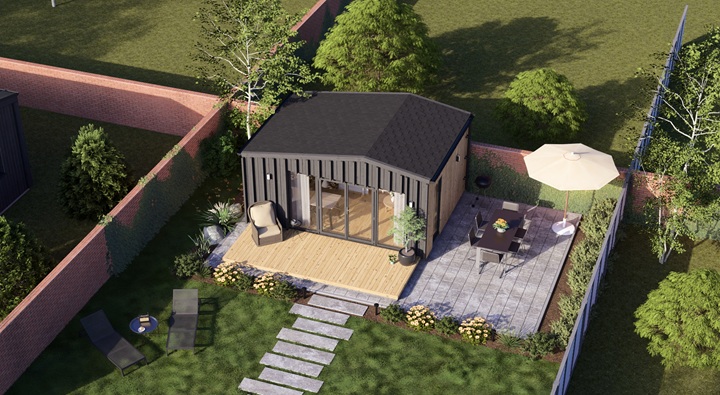
The base and structure of an outside office and its degree of usefulness throughout the year contribute a maximum of 20 points in the section Structural Permanence. Such elements prevent structural-related damage courtesy of adverse weather conditions. The foundation selection depends on the climate, soil condition, and local building regulations. Solid slab foundations are a strong option that would cost £5.40-£8.20 per sq ft on average.
According to local planning authorities, there are usually building codes and permit requirements, as the municipalities tend to require permits for accessory structures. However, many local authorities exempt smaller structures from a full building code review. Structural design must consider local wind speeds and snow loads, as these can have an important impact. Roofing materials often include metal roofing (which costs from £5 – £16 per square foot for materials) or asphalt shingles (which cost from £3 – £5 per square foot for materials).
Weatherproofing the entire building envelope is essential.
Maintenance planning and access is essential for longer-term durability. To maintain both appearance and functionality, the exterior should be inspected and maintained regularly. In certain instances, it is essential to regularly clean the gutters at different seasons or remove the snow on the roof so that there is no leakage and also avoid any damages.
Investing in an efficient outside office that can be used throughout the year is a great idea for remote professionals. A well-rounded climate control system, reliable connectivity, ergonomic design, and resilient structures work together for a seamless environment. Emphasising these factors will transform an outside office from a seasonal novelty to a year-round asset.
If you are looking to build, use the 4-Season Viability Framework to objectively assess your potential designs. Score of 75 or better means it should function year-round. Conducting phased implementation may help manage initial costs. First priority should be structural integrity and essential utilities. Then add premium finishes later. The most efficient outside office is not just any shed; it is a carefully designed extension of yourself that can withstand the different seasons.
Disclaimer: MoneyMagpie is not a licensed financial advisor and therefore information found here including opinions, commentary, suggestions or strategies are for informational, entertainment or educational purposes only. This should not be considered as financial advice. Anyone thinking of investing should conduct their own due diligence.
Your money-making expert. Financial journalist, TV and radio personality.