







Jasmine Birtles
Your money-making expert. Financial journalist, TV and radio personality.



 Vicky Parry
4th Dec 2025
Vicky Parry
4th Dec 2025
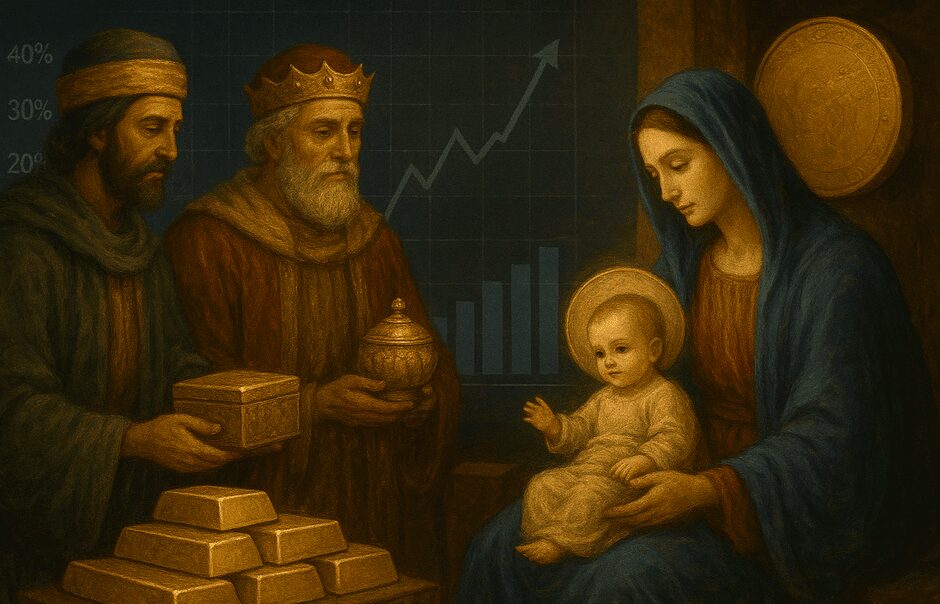
When the wise men visited the infant Jesus, they offered gold, frankincense and myrrh. These were not casual tokens, but treasures: exotic, rare, and deeply symbolic. Viewed through the lens of modern markets, those offerings can be regarded as a kind of ancient alternative‑asset allocation — and their worth, today, remains startling.
In the ancient Near East, gold signified wealth and kingship, while frankincense and myrrh were prized resins: valuable not only for ritual and aromatic use but also for medicinal and anointing purposes. Over centuries, Christian tradition added further layers of meaning — gold for kingship, incense for ritual honour, and myrrh as a symbol of mortality and sacrifice.
Yet in a modern economy, rarity and symbolic value do not always translate into market value. While gold remains a universally accepted store of value, the relative monetary worth of incense resins has diminished dramatically.
Using current UK gold‑price benchmarks and typical resin‑market valuations yields the following estimate:
On that basis, a gift bundle consisting of 1 kg of gold plus a few kilos of resin would be overwhelmingly gold‑driven: the resins adding only a modest fraction of the total value.
Viewed in modern monetary terms, the “net worth” of the Magi’s gifts would effectively rest on gold. That remains a demonstration of the enduring role of bullion as a store of value — a principle that underpins the work of Bullion Club. Indeed, bullion‑holding organisations such as Bullion Club make a compelling case for gold as a stable, long‑term wealth‑preservation asset.
At the same time, the dramatic fall in relative value for incense resins illustrates how changes in supply, demand, trade networks and technology can shift which resources are truly “precious.” What once represented luxury and rarity may become affordable commodity.
Thus the gifts combine two forms of value: one financial (gold), and one symbolic (resin). In an age dominated by liquid financial instruments, the Magi’s bundle is a reminder that some of the most venerable stores of value remain rooted in tangible assets.
For any modern investor or wealth‑preservation enthusiast, that historical parallel offers a compelling case for gold.

Direct to your inbox every week
New data capture form 2023
Your money-making expert. Financial journalist, TV and radio personality.







Leave a Reply